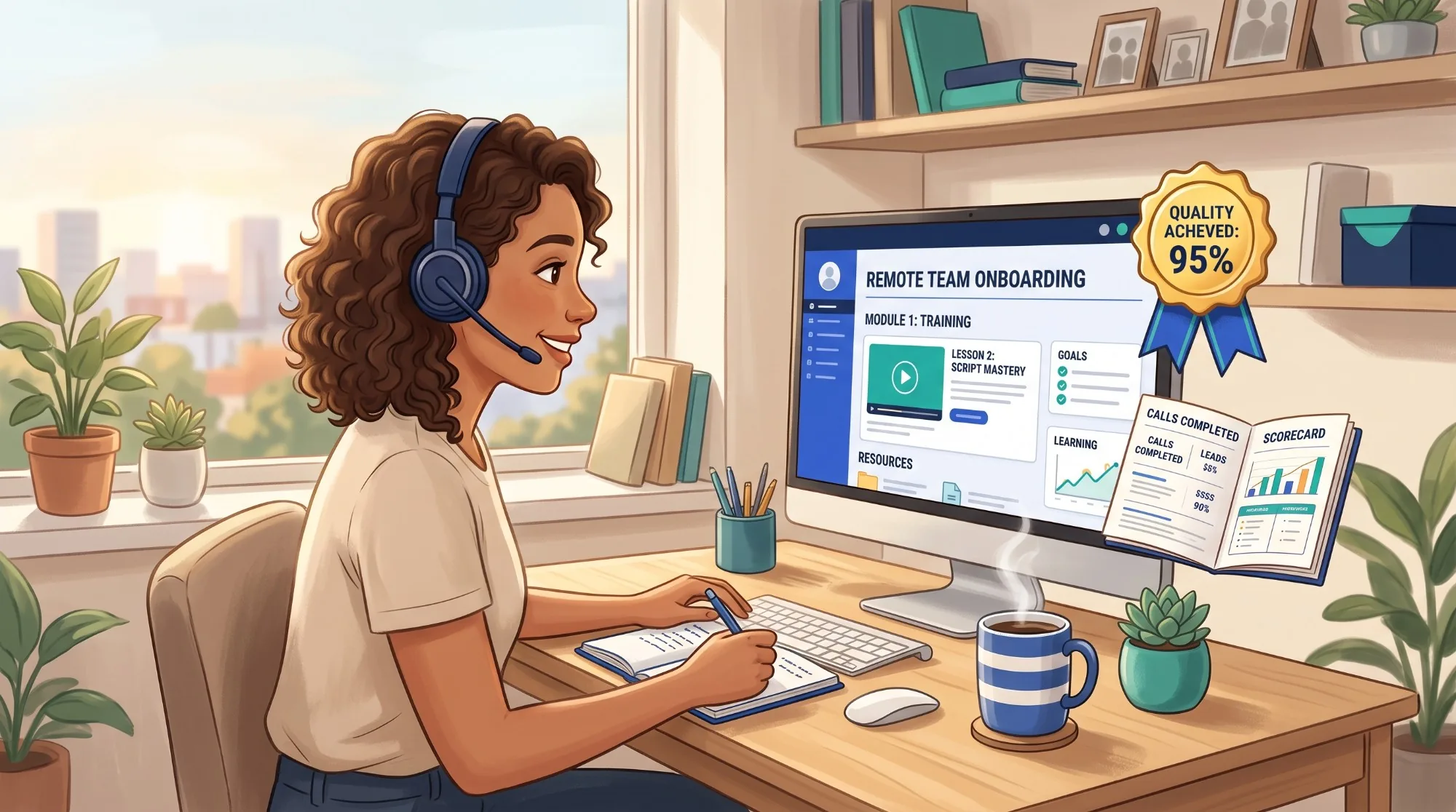
What is an acquisition call scorecard?
An acquisition call scorecard is a fixed rubric applied the same way to a sample of a floor's calls, so coaching rests on a repeatable pattern instead of the loudest seller complaint. It scores the open, discovery, condition, objection handling and the next step, plus a separate pass-fail line for compliance.
Why "listen to more calls" stops working past five reps
A one-person acquisition floor doesn't need a scorecard - the owner hears every call. The problem shows up at five or six reps, when nobody has enough hours in the week to sit on every dial, and "quality" becomes whatever the loudest complaint from a seller happened to be that month. An acquisition call scorecard is the fix: a fixed rubric applied to a sample of calls, scored the same way every time, so coaching is based on a pattern instead of a mood.
What actually belongs on the scorecard
Real-estate acquisition calls have a shape - sellers are being assessed on motivation and condition, not just being pitched - so the scorecard should follow that shape rather than a generic sales checklist. A working structure most floors converge on:
- Open: did the rep set context for the call in the first 15 seconds instead of launching straight into a script?
- Discovery: did the rep ask about timeline, why now, and what happens if the house doesn't sell - not just "are you motivated"?
- Condition: roof, foundation, systems, occupancy - enough detail that comps and repair estimates aren't guesswork later.
- Objection handling: did the rep stay in a real conversation on "I need to think about it" or "I already have an offer," or revert to pitching?
- Next step: did every call end with a specific, scheduled action - not "I'll follow up"?
- Compliance checkpoint: a simple pass/fail line - no pressure tactics, no promises the company can't keep, correct handling if the seller asks to be removed from the calling list.
Score the compliance line as pass/fail, not 1 to 5. A rep who nails discovery but fails the compliance line has a real problem that a high average score would hide.
How many calls to actually sample
You don't need to grade every call, and trying to is how QA programs die of their own workload. Call-center quality benchmarks converge on a workable range: Call Centre Helper's research on QA sample sizes puts five to six calls per rep per month as the point where a sample is large enough to be representative without eating a manager's whole week - with newer reps or anyone on a performance plan bumped up toward ten to fifteen. Pull the sample randomly, not from a rep's best or most recent calls; grading only the calls that already went well tells you nothing about where the floor is actually leaking deals.
Score in two buckets, not one number
A single blended score flattens two different problems into one number and makes both harder to fix. Split the rubric instead:
- Technique (weighted 1 to 5 per item): discovery quality, objection handling, next-step clarity. This is coachable skill - it moves gradually.
- Critical items (pass/fail): the compliance checkpoint, and anything that's a hard stop regardless of how smooth the rest of the call was.
A rep who passes every compliance check but can't handle a stall is a coaching case. A rep who closes beautifully but fails compliance is a liability case - the two shouldn't average into a score that hides which one you're looking at.
Calibrate before you trust the numbers
If more than one person grades calls, run a short calibration session before you compare anyone's scores: have two managers independently score the same three or four calls and talk through where they disagreed. Without this step, "score" measures which manager graded the call as much as it measures the rep - and reps notice when the same call would score differently depending on who's listening.
Close the loop, or the scorecard is just paperwork
A scorecard that produces a number nobody acts on is overhead, not QA. The loop that makes it worth running: score the sample, pick one or two recurring gaps per rep rather than listing everything wrong with a call, and get that feedback back to the rep inside a day or two - while the call is still fresh enough that the correction lands. A monthly summary of last week's calls is too slow to change next week's dials. It also works both directions: if the top-scoring reps on discovery are also the ones converting appointments to signed contracts, that's confirmation the rubric is measuring the right thing. If it isn't, the rubric needs to change, not the reps.
Where this fits with 30/60/90 ramp and the offer itself
A scorecard is the measurement layer, not the whole coaching program - pair it with a structured onboarding ramp for new reps and a clear standard for how the offer itself gets built on the call (comps to ARV to a defensible number, not a guess read off a script). See how to cold call successfully in real estate for the discovery-question side of this, and how live call coaching actually works for the in-the-moment half of the loop a scorecard alone can't cover, since a scorecard only ever grades a call after it's already over. Turning a scorecard's findings into coaching and ramping reps at scale is what keeps that loop closing for every new rep, not just the ones a manager happens to catch.
Frequently asked questions
How long should a scorecard be? Short enough that a manager can score a call in the time it takes to relisten to the two-minute stretch that mattered. Six to eight line items is a reasonable ceiling - past that, reviewers start rushing through items instead of actually judging them.
Should reps see their own scores? Yes, and ideally reps self-score a call before the coaching conversation. Comparing a rep's self-score to the manager's score is often more useful than the score itself - it shows whether the rep can hear their own gaps.
What if we don't have time to grade calls by hand every week? That's the real constraint most floors hit, and it's why manual QA programs quietly stop happening around week six. CallVisor scores every call against a rubric like this automatically and coaches reps in real time on the dial, so the QA layer above doesn't depend on a manager finding four spare hours a week. Get Early Access if that gap is the thing killing your QA program.
- acquisitions
- call quality
- coaching
- cold calling
- real estate wholesaling