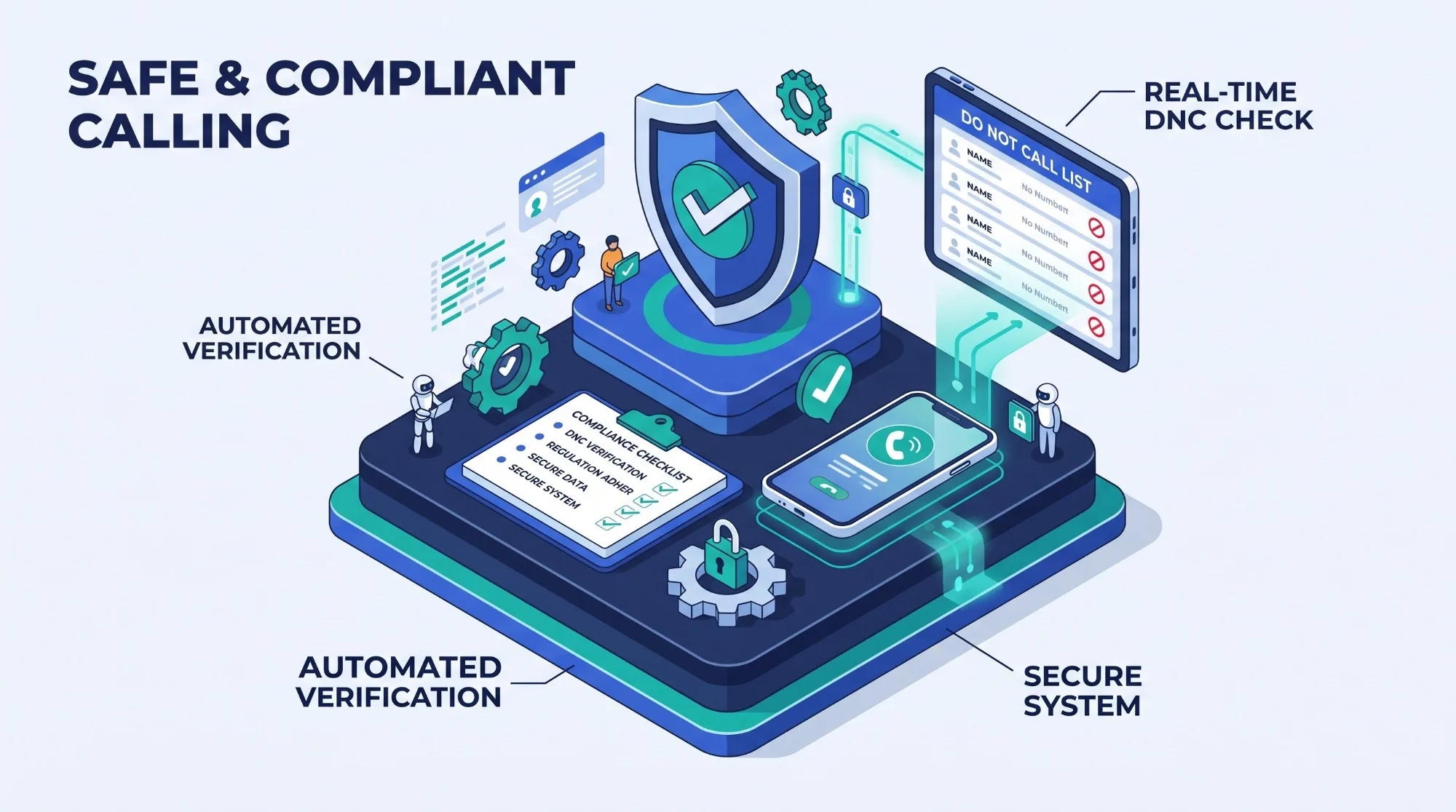
What are the TCPA and DNC rules for calling pre-foreclosure lists?
The TCPA and DNC rules for calling pre-foreclosure lists mean scrubbing every number against the National Do Not Call Registry and your internal do-not-call list, dialing only inside the stricter of federal and state calling hours in the recipient's time zone, and honoring opt-outs within the federal deadline. Texting the list adds written consent, carrier registration and STOP handling.
Why the pre-foreclosure list is the one to get right
Pre-foreclosure is the highest-stakes list a wholesaler dials. The seller is in distress, the data comes off public NOD and lis-pendens filings, and the person on the other end is scared, embarrassed, or both. That combination draws attention - from regulators and from plaintiffs' attorneys. One off-hours dial or one ignored opt-out on a list like this is not a rounding error. It is a statutory violation with a dollar amount attached.
This guide walks the actual rules for calling pre-foreclosure lists: who they apply to, where wholesalers get tripped up, and the checklist that keeps a floor clean. It is a working overview, not legal advice - the statutes shift with case law, so run your own program past your own counsel before you rely on it.
The three rulebooks, not one
People say "TCPA" as if it covers everything. It does not. A cold-call operation touches three separate legal surfaces, each with its own consent standard:
- Placing the call. Governed by the TCPA (47 U.S.C. § 227) and the Do Not Call rules (47 C.F.R. § 64.1200).
- Recording or transcribing the call. Governed by the federal Wiretap Act (18 U.S.C. § 2511) plus state consent statutes.
- Texting the lead. Governed by the TCPA again, plus the carriers' A2P 10DLC registration mandate.
Get one right and you can still be exposed on the other two. Treat them as three checklists, not one.
Does "we buy houses" get a pass on the DNC rules?
This is the question every wholesaler asks, and the honest answer is: don't bet your business on it. The DNC rules apply to "telephone solicitations." Some argue that an offer to buy a home is not a solicitation to sell anything, so it falls outside the rule. Two federal district courts agreed in 2025, one of them in the Eastern District of California (National Law Review). But in June 2026 the Ninth Circuit reversed the other, in Coffey v. Fast Easy Offer, holding that a call or text is a telephone solicitation if one purpose of sending it is to sell a service, such as brokerage, and it left open whether a pure offer to buy is one.
The question is not settled. Courts have split, states enforce their own Do Not Call laws against real estate companies that cold call homeowners (California's Attorney General sued MV Realty, a brokerage that telemarketed cash-for-listing deals, under the state's do-not-call law among other claims in 2023, per the California Attorney General, and won a preliminary injunction in 2024), and many state mini-TCPA statutes define solicitation more broadly than the federal rule. As real-estate compliance commentators have noted, "I buy houses for cash" reads as textbook solicitation to most regulators. The safe operating posture is simple: assume the DNC rules apply.
In practice that means two scrubs, not one. Check every number against the National Do Not Call Registry, and keep your own internal do-not-call list of anyone who has asked you to stop - the internal list is a separate legal duty under 47 C.F.R. § 64.1200(d), and it is the one most floors forget. The downside of getting this wrong is up to $500 per violation under 47 U.S.C. § 227(c)(5), which a court can treble to $1,500 for willful or knowing violations, and these cases are often filed as class actions.
Calling hours, autodialers, and the opt-out clock
Three more TCPA rules bite on a pre-foreclosure floor:
Calling hours. No telemarketing calls before 8 a.m. or after 9 p.m. in the called party's local time, not yours. Several states are stricter. If you dial nationwide off one clock, you will break this rule in another time zone - build the guardrail into the dialer, not the rep's memory.
Autodialers. In Facebook v. Duguid (2021), the Supreme Court narrowed what counts as an autodialer to equipment using a random or sequential number generator. A dialer working through a list you uploaded is generally not an autodialer under that ruling. Two caveats keep it from being a free pass: prerecorded and artificial-voice rules still apply no matter what dials the call, and some state laws (Florida's FTSA, for one) define "autodialer" far more broadly than the federal standard.
Revocation. Under the FCC's 2024 opt-out order, a consumer can revoke consent by any reasonable means, and you must honor it within 10 business days. A seller who says "take me off your list" on a call has revoked. That request has to reach your internal DNC list fast, and stay there.
Recording the call: assume all-party consent
Federally, one-party consent is enough - your rep is on the call, so your rep can consent to recording it. That baseline is a trap for a nationwide floor. Roughly a dozen states require all parties to consent, and when you dial a list off public filings you rarely know which state the person picked up in. California has even applied its stricter law to out-of-state firms recording calls with Californians, so the strictest state tends to win.
The fix is boring and it works: announce it. A short line at the top - "this call is being recorded" - followed by the seller staying on the line is treated as consent in all-party states. Say the words; a beep alone is not enough in several states. And note that AI transcription is treated the same as recording under these statutes, because it captures the contents of the call. If you transcribe, disclose it the same way.
The harder problem on a pre-foreclosure floor is not whether you recorded - it is what got said. A rep who slips into a pressure tactic or a promise the company can't keep is a liability, and you only find out if someone reviews the call. A compliance checkpoint belongs on the same rubric you grade technique with - pass or fail, not a 1-to-5 score. This is where live call coaching earns its place: CallVisor coaches reps in the moment and scores every call against a rubric like that, including a compliance line, so a floor you can't personally listen to still gets caught before a bad habit sets. See the acquisition call scorecard for how that checkpoint fits the rest of the review.
Texting pre-foreclosure leads: A2P 10DLC and STOP
Texting looks lighter than calling. Legally it is not. Under the TCPA, a text is a call. A marketing text needs prior express written consent - an unchecked box, clear disclosure, and a saved record of it. A cold text to a pre-foreclosure homeowner who never opted in is the same violation as a cold prerecorded call.
On top of the law sits a carrier mandate. To send business texts from a normal 10-digit number, you register your brand and your campaign through The Campaign Registry (A2P 10DLC). Since February 2025, the major carriers block unregistered traffic outright - not throttle it, block it. So unregistered texts fail two ways: they may be illegal, and they may not even deliver. Honor STOP immediately and keep the suppression, the same as a call opt-out.
A pre-call compliance checklist
The operator version, in order:
- Scrub every number against the National DNC Registry and your internal do-not-call list before it hits a dialer.
- Gate calls to 8 a.m. to 9 p.m. in the recipient's time zone, and tighten it for stricter states.
- Announce recording at the top of the call, in words, and disclose transcription the same way.
- When anyone says stop, log it to your internal DNC list within the day - never 10 days later.
- Get written consent before you text, register your 10DLC brand and campaign, and honor STOP on the first reply.
- Keep the records: consent proof, DNC scrubs, opt-outs, recording settings. In a dispute, the record is the defense.
Your own do-not-call list is easier to hold in software than in a rep's memory. A dialer built for real estate wholesalers carries do-not-call handling and TCPA-conscious calling in the outreach workflow, but the National Registry scrub, each recipient's local calling window, consent and records stay the calling party's job, and so does a review by its own counsel.
The line between compliant and predatory
Passing every statute above still leaves the part regulators watch most on distressed-property calls: tone. A homeowner in pre-foreclosure is not a lead to be pressured. Rushing them, implying you're with the bank, or promising a rescue you can't deliver is how a legal call becomes an enforcement complaint - and how a wholesaler's name ends up on a list nobody wants to be on. Compliant and decent are the same discipline here. The reps who close pre-foreclosure deals do it by sounding like a way out, not a trap.
Frequently asked questions
Can I legally cold call pre-foreclosure homeowners at all? Yes, if you follow the rules - scrub the DNC lists, respect calling hours, honor opt-outs, and don't use a prohibited dialer or a prerecorded pitch without consent. "Legal" and "no scrubbing needed" are not the same thing.
Do I really need consent to record? Federally, no. But because you rarely know the recipient's state on a public-filing list, assume all-party consent applies and announce the recording at the start of every call.
Is texting safer than calling? No. A text is a call under the TCPA and needs written consent, and carriers now block unregistered business texts. Cold-texting a pre-foreclosure list carries the same risk as cold-calling it.
Does an established business relationship help? It can create a narrow exception to some DNC restrictions, but it is easy to overclaim and hard to prove. Don't build a program on it without counsel.
This article is general information, not legal, financial, or investment advice. Real Invest Republic / CallVisor is not liable for decisions made based on it. Consult a qualified professional (attorney, CPA, or licensed advisor) about your specific situation at your own discretion.
Compliance on a pre-foreclosure floor comes down to two things: the guardrails in your dialer, and whether anyone hears what your reps actually say. CallVisor handles the second - live coaching on the dial and automatic call scoring against your rubric, compliance checkpoint included - so the floor stays clean even when no manager is listening. Get Early Access to put it on your team.
- tcpa
- dnc
- pre-foreclosure
- cold calling
- compliance