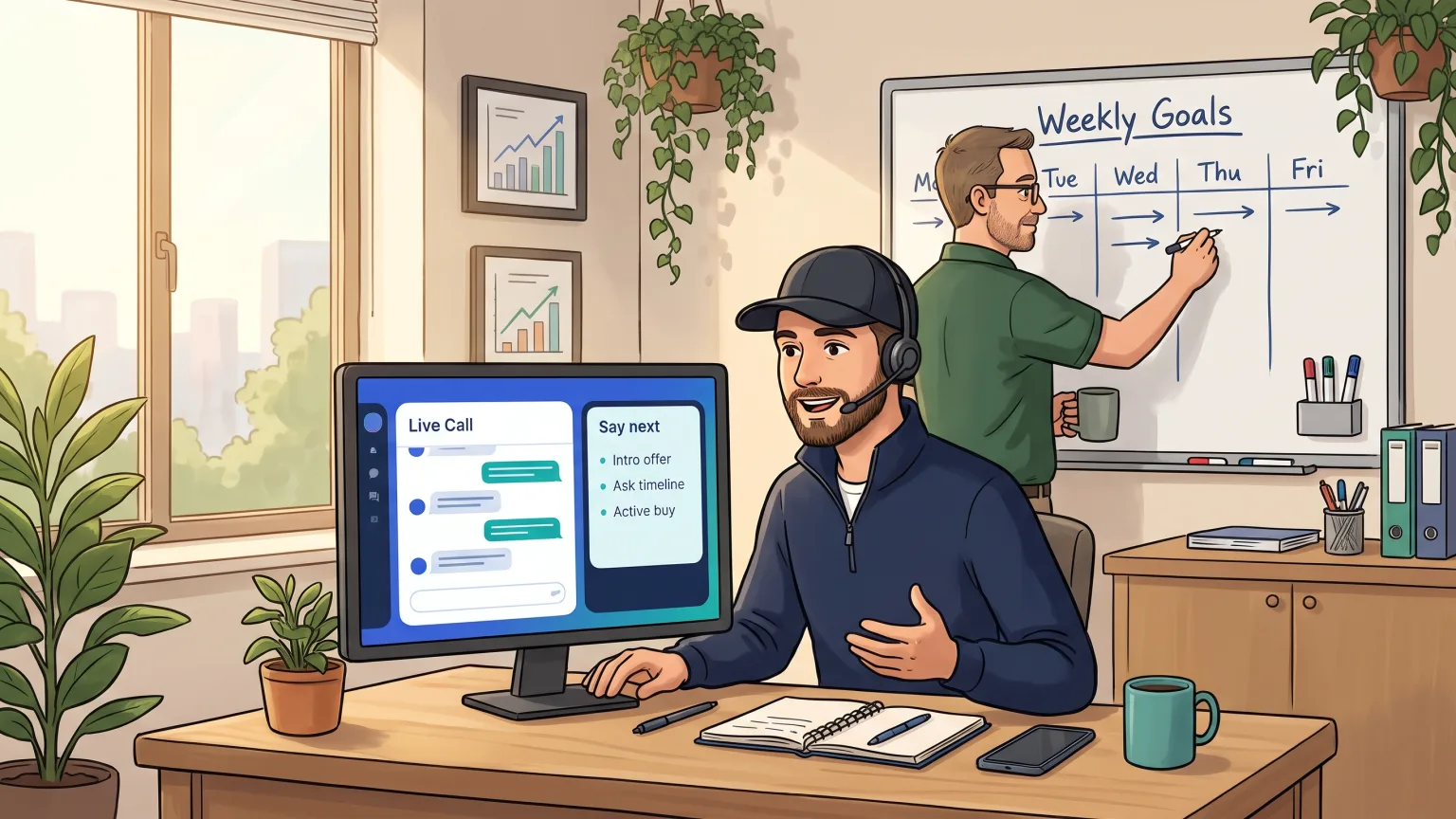
Which one does a small acquisitions team need?
For a small acquisitions team, AI call coaching and a sales manager do different jobs, so the real question is which job is going unfilled. AI coaching covers every call, in the moment, on the basics: the open, the questions, the objection, the next step. A manager covers judgment: deal strategy, hiring, motivation, and the hard conversation after a bad week. If you run a handful of seats with no manager, the unfilled job is coverage, and that is the one AI fills well. Settle AI call coaching vs sales manager by deciding who owns each job on your floor.
What a sales manager does that software cannot
A good manager reads the person behind the call. They notice the rep who is quietly burned out, the VA who needs a different kind of feedback, the closer who is hiding a bad habit behind good numbers. They also own decisions: which list to work, when to pull a rep off a campaign, whether a deal is worth chasing at a thinner spread.
On an acquisition floor, the manager is also the one who negotiates. When a seller wants more than the numbers allow, a human with experience decides whether to walk, restructure, or bring in a creative-finance option. No coaching tool should make that call for you. That is the part you keep, even if you never hire a manager, because you are the one who owns the deals.
What a manager cannot do on a small floor
On a small floor the limit is hours. A manager can only listen to so many calls, and a typical manager hears a small slice of what the floor says in a week. The rest goes by unheard. Feedback then arrives days later, about a call the rep barely remembers. If your reps are offshore VAs, add the time-zone gap: the best moment to coach is live, and your manager is asleep.
Hiring one also takes a real budget line, and many two-to-five seat floors cannot carry a full-time manager yet. So the owner ends up as the manager by default, listening when time allows and guessing the rest. We covered how to run that loop by hand in how to coach cold callers you can't listen to.
What AI call coaching does well
AI has the opposite profile. It scores the dull calls as closely as the good ones, and it is awake when a VA dials at three in the morning your time. It can score every call against the same rubric, and it can coach during the call instead of after.
- Coverage: every dial gets scored, not a sample. Patterns show up in your data instead of in your gut.
- Timing: a live nudge lands while the seller is still on the line, which is when a correction can change the outcome.
- Consistency: the same standard applies to the owner's best rep and the newest hire.
- Your time: you review exceptions and trends instead of listening to recordings.
This is the gap CallVisor is built for. It coaches the rep on the live call and scores every call against a scorecard, so a floor without a manager still gets a coaching layer. You can see how the pieces fit on the CallVisor features page, and the mechanics of live coaching are in how AI coaching works during a live sales call.
Where AI coaching falls short
AI does not know your market, your buyers, or why you passed on a deal last month. It cannot motivate a discouraged rep or decide when to fire one. It is only as good as the rubric behind it, so a lazy scorecard produces lazy coaching. And a generic model trained on other industries can miss real estate objections like "I need to talk to my spouse" or "I already got a cash offer." Judge any tool on whether it understands motivated-seller calls, not on a demo with a SaaS script.
Keep a human in the loop for anything involving compliance or fairness to the seller. If a call goes sideways, a person should decide what happens next.
How to split the job on a small team
Give the machine the work that needs volume, and keep the work that needs judgment.
- Write the standard yourself. Start from an acquisition call scorecard: open, discovery, condition, objection, next step. The tool enforces it, but you decide what good looks like.
- Let AI score and coach every call. This is the daily layer. It replaces the listening you were never going to have time for.
- Review the exceptions. Look at the lowest-scoring calls and the reps who are not improving. Spend your hour there.
- Keep the human conversations. A weekly one-on-one with each rep, deal reviews on live negotiations, and every hiring decision stay with you.
- Add a manager when judgment, not coverage, becomes the bottleneck. If the scores are healthy but the team still stalls on strategy or morale, that is the signal to hire.
If you are still building the team, the people side matters as much as the tooling. See how to find high-quality cold callers before you scale seats. And if you want the broader case for coaching across a floor, coaching reps at scale lays it out.
Frequently asked questions
Can AI call coaching replace a sales manager? Not fully. It replaces the listening and the after-the-fact feedback a manager cannot fit in, which is most of what a small floor is missing. It does not replace judgment, hiring, or negotiation strategy.
When should I hire a manager instead? When your calls are scored well and coached consistently, yet deals still stall on strategy, motivation, or process. At that point coverage is solved and judgment is the bottleneck.
Does AI coaching work for offshore VA callers? It suits them, because the coaching happens on the call, in the rep's own shift, with no overlap in hours needed. You still set the standard and review the trends.
If you run a small floor and nobody is coaching the calls, put a coaching layer on every dial first and keep your own time for the deals. Start Free Trial to try it on your team.
- ai coaching
- coaching
- team management
- call qa
- acquisitions
- va callers